Sunday, July 7, 2013

Phelps Mountain

Location: Adirondack Mountains, Essex County, New York
Season Visited: Summer
Trail Length: 8.8 miles there and back
Time to Hike: Six hours
Difficulty Level: 5

Adirondack Park  is an absolutely huge state park in northern New York.  It's a hiker's dream, with over 2,000 miles of trails to explore.  One of the most enticing regions of the park is the Adirondack High Peaks, the 46(ish) peaks that are over 4,000 feet high.  I decided to hike Phelps Mountain, which is supposedly one of the "easier" high peaks at 4,160 feet.  It was anything but easy, but it sure was beautiful.

The hike begins at the Adirondack Loj (actually the parking area right before the Loj).  There is a $10 parking fee.  Stop by the office once you've parked.  There are friendly and knowledgeable staff that advise you on the changeable mountain weather and give you tips for hiking trails that you haven't done before.  The trailhead is also used for Mount Marcy, among other hikes, and enters the High Peaks Wilderness Area.


Begin at the trailhead by the parking lot.  The trails are very well marked.  Be aware that the mileage listed to Phelps Mountain is only to where the ascent begins and doesn't include the actual climb up the mountain.  Sean and I had originally been under the impression that the trail was 6.8 miles long, but it is 8.8.  Pace yourself.  The mile up the mountain is absolutely brutal.

For a time you'll simply be walking in the woods, and it will be moderately easy.  You'll come to a boardwalk.  There are many small boards along the way, but this is an all-out boardwalk.  Enjoy the ease - while you can...


Also enjoy being in Middle Earth!

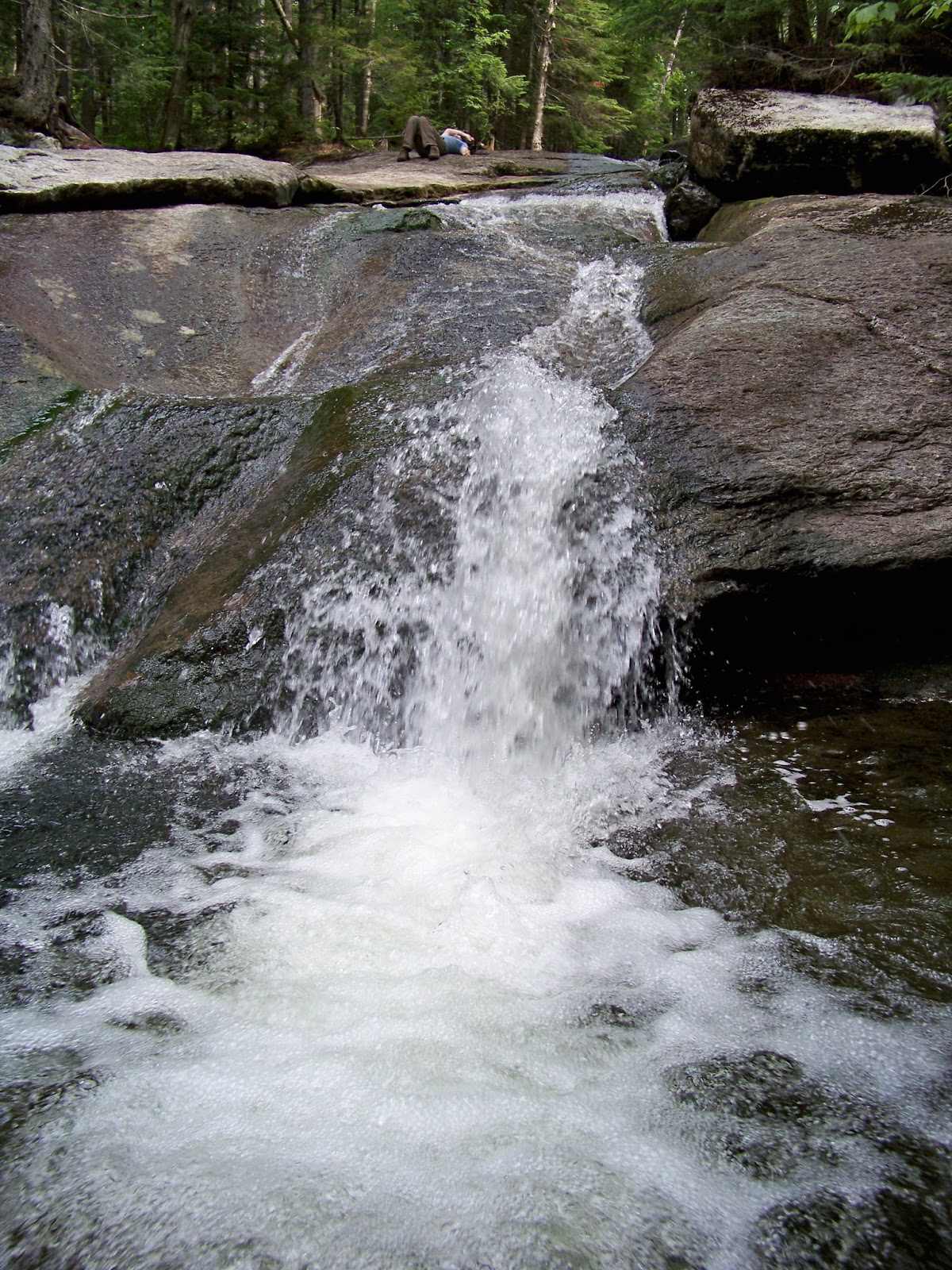
There are many gorgeous streams and little cascades along the way if you veer slightly off the trail.  I recommend stopping at them to rest and take pictures.  Some would make great swimming areas, but remember that this is mountain water.  It's freezing!

There are lots of cute frogs and toads around here.


Sean resting on the rocks.

After a while you will come to one of the highlights of the hike - Marcy Dam.


Cross the water bridge to continue on your journey.

After the dam is a registration station.  You should be sure to register, especially if you're in a small group.  The mountain club sends out rescues for hikers who don't return.

After some more deep woods hiking you'll come to High Water Bridge and its little waterfall.  I should also mention that between Marcy Dam and High Water Bridge you will have to do a stream crossing.  There are plenty of rocks to cross on, and we went right after a torrential rainstorm, so you don't need to worry about actually getting wet.  Just be aware that this moment does come.

High Water Bridge.


Continue on your hike until you come to this sign:


At this point you have hiked 3.4 miles.  I highly suggest mentally preparing yourself for the mile to come.  It is, without question, the most difficult mile I have ever hiked.  We saw about five other groups on our hike, and everyone agreed - this section of the trail might technically be one mile, but it feels like five.  It is an arduous uphill climb.  And yes, it is a climb.  Almost the entire mile is made of rock scrambles.  Since, as I mentioned earlier, we went right after a downpour that lasted several days (and actually continued after our hike), we were also climbing little slippery waterfalls.  I advise you to be prepared for these conditions.  Oh, and one other thing - BRING BUG SPRAY.  The bugs became a joke amongst the hikers we saw, but it was more of a laugh-or-you-are-going-to-cry thing.  I'm against that hardcore DEET stuff just like every other intelligent person on the planet, but there's a reason they're still making it.  This is one occasion where you'll need it.  Trust me.

The climb up Phelps Mountain was so difficult that I really didn't have the time (or willpower) to take pictures of all the wonderful rock scrambles.  Here's what I did get, though.

The trail at this point is really just rocks.

One of the more mild rock scrambles at the bottom, before I stopped taking pictures of them.

Resistance to the water was futile.


Clintonia at a break point.

Remember how I said to mentally prepare yourself?  I said this not only because of the physical difficulty of the trail, but because this mile seems to go on forever.  You get to the point where you realize you're really high up and start getting the first of the spectacular views to come.  You think to yourself, "Wow, I'm almost to the summit!"  And then you continue to think this for the next hour.  I would hazard a guess that the first four or five times you think you're almost there you actually aren't.  Fortunately, the views keep tempting you to climb higher...

You're about 20 minutes from the summit when you hit this view.

There is an excellent photo spot only 5 minutes from the summit.  It's a little less buggy than the very top, but you really can't beat the views from the summit itself.  After all of your hard work, you deserve to soak in the splendor.


It's almost impossible to avoid the mud in the trails near the summit if you've been hiking after rain.


Don't forget the photos!

Obviously, the views of the surrounding high peaks are beyond spectacular.  Are they worth the climb?  Absolutely.  Unfortunately, hiking in June means you might not be able to relax at the summit due to the bugs.  Lucky for you, the climb down the mountain is much easier than the climb up it.  Just be wary of slippery rocks.  I did fall more than once.

You are bound to be pretty exhausted after your journey down the mountain.  Stop at a creek to rest.  You can actually take a little nap by the running water without getting eaten alive.


The walk back is mostly pleasant, depending on your stamina.  Since I don't get to hike something this intense more than once a year or so, I was pretty much out of all the stamina I possess about two miles from the parking lot.  I walked those last couple miles feeling like a zombie.  Fortunately, someone was encouraging me.


About a mile after this sweet but spelling-challenged mushroom, the end is in sight.  Even with our frequent breaks, we made it through the hike in exactly six hours, having started at 10:30 and ended at 4:30.  For reference, it was only about noon when we got to the Phelps Mountain sign, so that's how much longer it took us to complete that section and then return.  Half of the time spent on our 8.8 mile hike was spent on the 2 miles of Phelps alone.  In the end, of course, every bead of sweat (and there were a lot of them) is worth it.  This hike is invigorating and gorgeous, and certainly doesn't lack adventure.  When you're finished, you'll get the honor of saying that you have hiked one of the 46 high peaks!  Perhaps you'll even be on your way to becoming a 46er.  Enjoy your hike, and keep wandering!

Sunday, June 30, 2013

What Do I Bring on a Hike?

There are all sorts of lists out there telling you what to bring on a hike.  Some are incredibly detailed, others aren't.  I haven't seen any bad lists, but I have seen some filled with unnecessary stuff, or with instructions that are pretty dated.  Some hiking experts might disagree with my list, but this is what I bring when I'm going on a day hike that could last anywhere from one to eight hours (the typical length of my hikes at this point).  Obviously this list isn't suitable for multi-day backpacking trips.  I'll get back to you on that.

1. A backpack.  I use an awesome little Swiss Gear backpack that I've had since forever.  I've actually been unable to find it anywhere online, and since I didn't buy it for myself I unfortunately can't tell you where to get one!  The important thing is that it's super small and has just enough room to fit everything on this list - and nothing more.  I like it that way, because I don't ever want to be caught with too much stuff!

2. Water.  Probably the most important thing on the hike.  I used to use a Camelbak bladder but I got fed up with it and now I just use a water bottle (from Cambelbak).

This is the water bottle I use.  My hubby got it for me at Eastern Mountain Sports.

3. Food.  On a typical hike I will pack four separate food items to satisfy my hunger.  I'll pack something like PB&J and some carrot sticks for lunch and then trail mix and energy bars as snacks along the way.  Don't get caught hungry!

4. Camera.  This is up there with food and water for me, but not everyone likes to take pictures when they hike.  To each his own, but I always have my camera ready!

5. Map.  To be honest, you really don't always need a map.  This is like blasphemy to most hikers, but if you're on a well-marked trail and there aren't that many other trails nearby then you'll probably be fine.  Another thing you don't need on a normal day-hike is a compass, which is on a lot of hiking lists I've seen.  I have personally never used a compass on a hike.  It's not like I'm bushwhacking for goodness sake!  Of course, if you are bushwhacking or hiking somewhere really remote or something like that then by all means bring a compass, but if not, it's really not that hard to look at the sun and figure out the general direction in which you're travelling.

6. Shoes that are not going to fall apart.  You'll notice I avoid using the words "hiking boots."  Let's break this down.  Hiking boots are outdated.  There are some places you might want them, but on your average hike they're just too heavy to warrant.  You will want sneakers on your average hike.  I use the same pair of Nikes that I bought for like 35 bucks in high school and they're fine.  I usually also bring flip flops or water shoes in case I want to dip into a waterfall :)

7. Band-aids.  I am always happy I have band-aids.  I usually use them to prevent blisters, but if you get a nasty scrape they are useful then, too!  I break the rules of always bringing a ton of first-aid stuff with you.  Sorry, scouts, but you seriously don't need an entire first aid kit on a single-day hike.  If you know general first aid then you can makeshift whatever you need, especially if you're only a few miles from help.

Note - don't go cheap on the band-aids.  Buy the name-brand hard-core sports ones.  You'll be glad you did.

8.  Bug spray.  To be honest, I only bring bug spray after rain or if I'm going to a place that I know is super buggy.  But I put it on this list because when you need it, you NEED it!

I admit to using the don't-screw-around Deep Woods DEET stuff.  Yes, it's horrible for you.  But, as my husband said on our most recent camping trip, there are times when it just might be better to die of cancer later than blood loss now.  My advice is to only use it when you really can't take the bugs any more.  Also, be sure to shower as soon as possible after your hike.

9.  Sunscreen.  I am a sunscreen fanatic.  If you don't want burns/skin cancer, put it on!!!

People all the time ask me what sunscreen I use.  This is it.  Yes, I use SPF 100+.  Told you I was a fanatic!  But seriously, this is the best sunscreen I have tried.  I hate the slimy look sunscreen gives you.  This doesn't do that.

10.  Cell phone (optional).  This is the controversial one.  Hikers are always arguing about whether or not to take their cell phones on a hike.  Pro-phone people say, "What if there is an emergency?"  Anti-phone people say, "You can't escape into nature with a phone!"  I say, "To each his own."  9 out of 10 times I do bring my phone, just in case.  Especially since I have a smart phone, I know that there are lots of emergency situations I could use it in.  For example, I have a flash light app.  My phone could also help me make loud noises in the unlikely case of meeting an unfriendly bear or something.  However, I am really good about not checking it.  I guess if you're one of those compulsive phone-checkers you should save yourself the temptation and leave it behind.

These are the 10 items that I don't hike without.  There are other things that you may wish to bring along for various reasons.  Sometimes I'll bring a jacket in case I get cold.  Sometimes I bring toilet paper, if I know I'll be out for more than four hours.  Just think about the type of hike you're going on and imagine what else you might need.  Chances are you'll be fine with this stuff.

Enjoy your hike, and keep wandering!

Monday, June 17, 2013

Why We Hike

It's pretty obvious that I love to hike, as do thousands of other people worldwide.  But why?  What is it about walking for miles and miles that makes our hearts race with excitement, that makes us long for our next hiking adventure, and that makes us want to push ourselves harder and farther than we ever have before?  To find out, let's start at the beginning.

www.nps.gov

Throughout human history, people have travelled extreme distances for religious reasons, to find food, or to go to war or rule an empire, but no one seems to know when taking long walks became less about survival  (or obligation) and more about enjoyment.  Hiking is often associated with mountaineering, so perhaps we should look at climbers for an answer.  Darby Field was the first European to climb Mount Washington, a few centuries later Tenzing Norgay and Edmund Hillary climbed Mount Everest, and in 1985 Dick Bass became the first person to climb the Seven Summits.  This is a selective history, of course, but what I think is interesting about these events is that they were all firsts in one way or another, which leads me to one of my personal conclusions on why we hike: to explore the unknown.  In Darby Field's case, it is probable that Native Americans reached the summit of Mount Washington long before he did and that there were plenty of other unrecorded ascents, but he still achieved something special by going down in the record books as the first European who did it.  Norgay, Hillary, and Bass's cases are much more extreme, since only with the advent of modern technology in the forms of advanced gear and transportation could these men have achieved what they did.  Before Norgay and Hillary, no one had ever set foot on the summit of Everest.  Norgay and Hillary were some of my heroes as a child, and I'm sure I wasn't the only child to hold them in high esteem.  Being the first to "go where no man has gone before" holds a huge amount of prestige.  We all know the name of Neil Armstrong, or, as a more recent example, that of Felix Baumgartner.  Humans idolize those who explore new places, and I think we all feel a little of this when we hike, even if it's somewhere that we know has been explored.  Hiking encourages us to go new places, at least new to ourselves, and we can catch a little of the glory of exploration in this way.  After all, you only need to look in the YouTube comments to know that everyone wants to be "first."

www.theoutdoorsguy.com

But there's more than this, of course.  We know very well we aren't the first people to hike a trail, otherwise there wouldn't be a trail to begin with.  So why else do we hike?  I mentioned earlier that people have historically taken long journeys on foot for religious reasons.  While these pilgrims of old had the destination in mind - perhaps a shrine, Canterbury, or Mecca - the journey itself could also be seen as a road to enlightenment.

www.sacredsites.com

Centuries ago, many people didn't have to journey too far to find wilderness.  It was all around them.  Even city-dwellers could leave the confines of their homes and find a world untainted by pollution, noise, and waste.  I'm not trying to romanticize a time gone by (well, not too much), but I would argue that the wonder of the natural world is largely lost to us in the age in which we live.  Perhaps this is why, for some people, the road to enlightenment is one that winds up mountains, past waterfalls, and through forests.  Perhaps we hike to find the remnants of the world that we are killing.  The indigenous peoples of every country I can think of worshipped nature in some form or other.  Perhaps in taking the slowest means of travel available through the most remote natural regions we can access we hikers are searching for whatever is left of our ancestors' gods.

www.nybg.org

My last theory on why we hike is, perhaps, more modern.  Only in affluent societies do people have the desire to "work out" to be physically fit (everyone else is working too hard to have any problems in this area). A very practical reason some people may choose to hike is that it burns a hell of a lot of calories!  In an age of "extreme sports," hiking, while perhaps less adrenaline-inducing than skydiving or mountain biking, is still pretty intense.  Long-term backpacking through rough terrain in particular is plenty extreme!  While only the luckiest of people live in an area where they can hike daily, many people still choose hiking as an exercise.

boiseoutdoor.com

Of course, someone looking to slim down or tone up doesn't automatically turn to hiking.  This is why I think that the reason we hike is a combination of all of these things.  Hiking sets us on an adventure.  Even a short walk into familiar woods can provide us with a glimpse of something we may not ordinarily experience.  The song of a bird, the flight of a butterfly, the sighting of a chipmunk - these things bring us out of our insular worlds and into something much larger than ourselves.  Of course, how much longer it will be larger than ourselves we cannot be sure.  Hopefully, as more people discover the joy of hiking - whether for adventure, spirituality, fitness, or a combination of these - they will take a stand for a form of recreation that is so much more.

pinterest.com

Whatever your reason, don't stop wandering.

Monday, May 27, 2013

Millstone and Twin Valley Trails

Location: White Clay Creek State Park, Newark, Delaware
Season Visited: Spring
Trail Length: 1.3 and 3.9 miles respectively, or 5.2 miles combined.
Time to Hike: Millstone Trail takes only about half an hour to hike while Twin Valley Trail takes about two and a half hours.
Difficulty Level: Millstone Trail: 1.  Twin Valley Trail: 3.

White Clay Creek State Park is a lovely state park in Delaware that features mature forests, rolling farmlands, and some interesting historical landmarks.  On the border between Delaware and Pennsylvania, the park houses part of the Mason-Dixon Trail along with plenty of recreational activities besides hiking.

I, of course, go for the hiking.  While certainly no national park, White Clay Creek has very pleasant trails less than an hour from my home.  Twin Valley Trail in particular is a hike on par with many good hikes in more popular places.

Unfortunately, White Clay Creek's trail labelling system is only a few points short of awful.  The park uses posts marked with colored arrows instead of blazes, which would be fine if the website mentioned which trails correspond to which arrows... but it doesn't.  This is the real reason why I am reviewing two trails in this post: while trying to find Twin Valley Trail I accidentally hiked all of Millstone Trail first.  So you know, Twin Valley Trail follows the yellow arrows.  Of course, sometimes these don't show up where they should.

So, let's begin with the pleasant and easy Millstone Trail.  Millstone Trail is named for Millstone Pond, pictured here.


To get there, park at the New London Road parking area.  Look left of the the bathrooms and you'll see a trail going into the woods next to a field.  This is where you want to begin.

The beginning of the trail.

Follow this until you come to a left turn in front of a field.  It really doesn't matter whether you take the field trail or the dirt trail because you'll end up in the same place, which is a right turn at the corner of field and woods.  Follow the tree line all the way down to a sign for Millstone Pond.

You'll want to go left at this fork-type thing.

This trail takes you back into the woods, over some board walks, and past a really fun rock formation by the pond.

Sean and Cleo on the rocks.

Walk through the woods for a while and you'll come to some lovely fields perfect for birding along with another pond.  Look out for snapper turtles!


Cattail Pond.


The trail then leads you back to the parking lot where you started.

And that is Millstone Trail.  Short, sweet, and to the point!  Now onto the longer and more challenging Twin Valley Trail, which is the longest in the park with the obvious exception of the Mason-Dixon Trail.

This trail starts the same way, but instead of going all the way to the Millstone Pond sign you stop short at a small trail before that one that is unlabelled except for a post.  This leads you down through a weird overgrown exercise course with many forks and such.  Just try to make it to the bridge over the little creek and you'll be okay.

Part of the exercise course by the bridge.

You'll pass through some of the same things you did if you hiked Millstone Trail, but eventually you'll come to the wooded trail that you'll be staying on for the rest of the hike.  Just remember to follow the yellow arrows!

The interesting buildings and historical landmarks come near the beginning.  An old cellar and the border stone marking the line between Delaware and Pennsylvania are the features.  Stand in two places at once!


The border marker is in a small clearing by a road.  Head back into the woods and hike for a while through the hilly forest.  You'll come to bridges over creeks and at one point will have to walk a small piece down the road, but if you follow the arrows you'll be lead safely on a pretty, and pretty interesting, hike.  At one point you'll even come across an old abandoned car!  I can only speculate about how it got there in the middle of the woods.

Beautiful tall trees. 


After all of these things, you will finally emerge from the woods into some gorgeous farmland.  Follow the cut-grass trail and end up at the parking lot where you started.


All in all, hiking in White Clay Creek State Park is definitely worth it.  I plan to go back and hike the Bryan's Field Trail to see the starting point of the Mason-Dixon line.  If you live in South Jersey, Delaware, or south-eastern Pennsylvania and want to get outside for the day, this is a good way to do it!  Enjoy your hike, and keep wandering.